
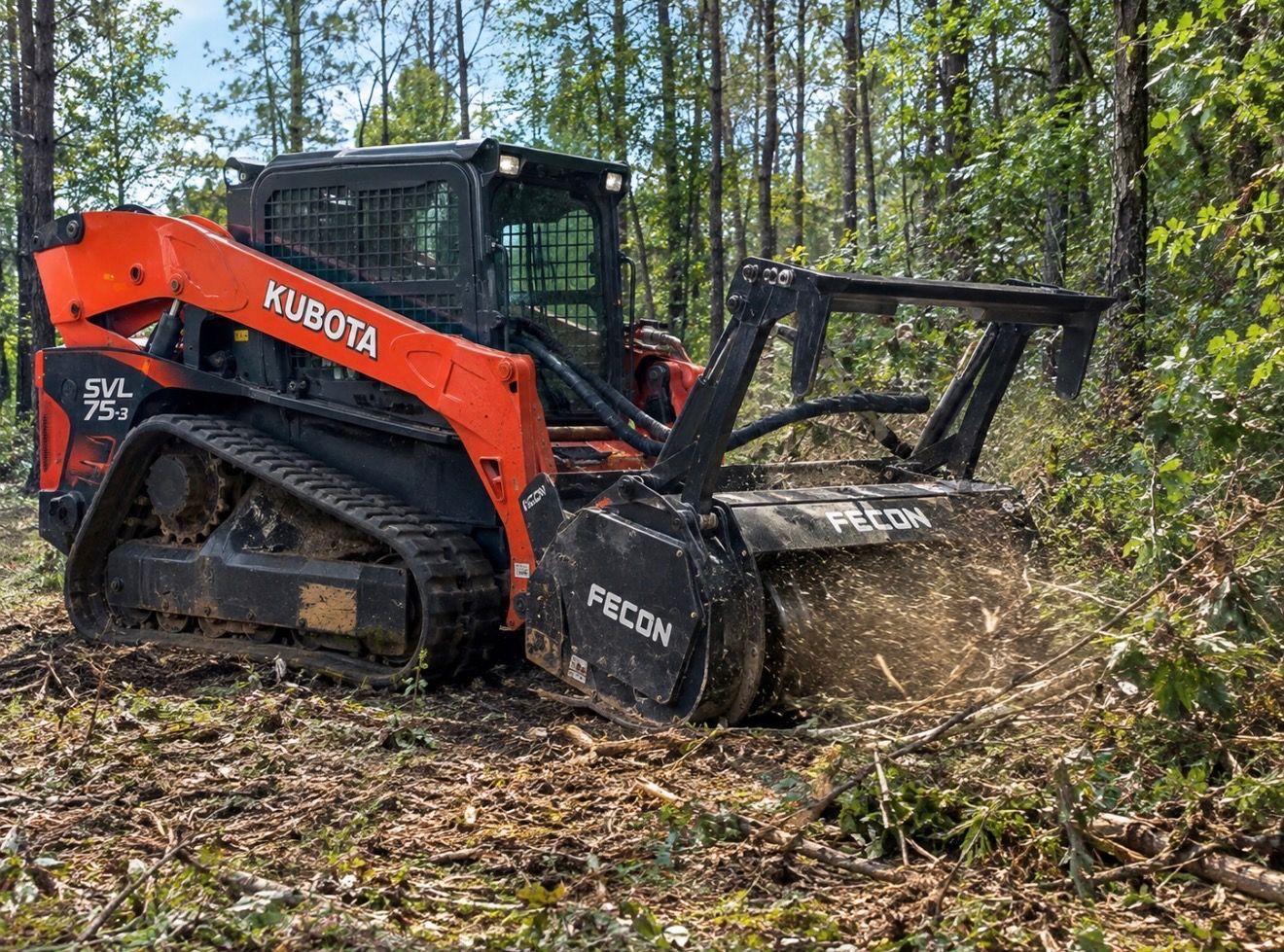
Land Cleared Without Destroying the Topsoil
Forestry Mulching in Moultrie for properties with brush, undergrowth, and unwanted vegetation
Dense undergrowth, invasive brush, and accumulated vegetation make large properties difficult to access, increase wildfire risk, and prevent landowners from using acreage for its intended purpose. Forestry mulching addresses these conditions by grinding vegetation in place rather than cutting and hauling debris off-site. South Georgia Land Service operates forestry mulching equipment across Moultrie, Georgia that processes trees up to six inches in diameter, brush, brambles, and saplings into a layer of shredded material that stays on the ground to control erosion and return organic matter to the soil.
The process uses a rotating drum with carbide teeth that cuts vegetation at ground level and grinds it into mulch in a single pass, eliminating the need for separate clearing, piling, and hauling operations. The finished mulch layer covers exposed soil, reduces erosion on slopes, suppresses weed germination, and decomposes gradually to improve soil structure without the compaction and topsoil loss that follows bulldozer clearing or burn piles.
Request a forestry mulching estimate based on your property's current vegetation density and clearing objectives.
What Forestry Mulching Accomplishes
Unlike traditional clearing that strips topsoil and leaves bare ground vulnerable to erosion, forestry mulching preserves the soil structure while removing vegetation that blocks access or creates fire hazards. The method works efficiently on uneven terrain where dozers would disturb drainage patterns, and it eliminates hauling costs and disposal fees associated with cutting and removing brush. The mulch layer left behind moderates soil temperature, retains moisture, and prevents the immediate regrowth that follows cutting alone by blocking sunlight from reaching dormant seeds and root systems.
After mulching, previously impenetrable thickets become open ground suitable for equipment access, trail development, or wildlife management, and the mulch blanket prevents the erosion that typically follows vegetation removal on slopes. You will notice that cleared areas remain passable even after rain because the mulch absorbs water and provides traction, and that desirable trees left standing are no longer competing with invasive understory growth for nutrients and sunlight. The land transitions from overgrown to managed without the scarred, barren appearance that follows other clearing methods.
Forestry mulching suits hunting land preparation by creating shooting lanes and food plot access without destroying ground cover that benefits wildlife, farm property improvements that open fence lines and equipment routes while controlling erosion, and development site preparation that removes vegetation before survey and engineering work begins. The process also maintains rights-of-way, reclaims abandoned pastures, and controls invasive species spread on large acreages where manual removal is impractical.
What Landowners Ask About Vegetation Clearing
Owners of large properties throughout Moultrie typically want to understand how mulching compares to other clearing methods and what results to expect.
What vegetation types does forestry mulching handle effectively?
The equipment processes brush, saplings, briars, and small trees up to six inches in diameter, but larger hardwoods and stumps require conventional cutting and removal rather than mulching in place.
How does forestry mulching reduce erosion compared to dozer clearing?
The mulch layer stays on the ground to absorb rainfall impact and slow runoff, whereas dozer clearing removes vegetation and topsoil together, leaving bare subsoil that washes away during the first significant rain event.
What happens to the mulch layer over time?
The shredded material decomposes gradually over one to three years depending on climate and moisture, adding organic matter to the soil and eventually allowing desired plantings or managed turf to establish without additional soil amendments.
When should forestry mulching be scheduled for hunting land or farm properties in Moultrie?
Late summer through winter allows clearing during dormant periods when ground conditions are drier and equipment can access properties without rutting saturated soil, and vegetation regrowth is slower following dormant-season clearing.
How is mulching priced relative to acreage and vegetation density?
Cost depends on the thickness of undergrowth, the diameter of material being processed, and site accessibility, with dense thickets requiring more time per acre than light brush or saplings that process quickly.
South Georgia Land Service provides forestry mulching for residential, agricultural, and commercial properties across Moultrie that require environmentally responsible vegetation management. Call (229) 338-6445 to discuss your property's clearing needs and schedule a site evaluation.